Category: Our Blogs

Warrior The War Horse – Every Horse Remembered: a moment to reflect

I received this email as a poignant reminder of how cruel wars are, not just for the brave men and women who fought in them, but for the horses, mules and donkeys who were taken from their homes to a world of horror no-one could have dreamed of.  The unsung heroes.

Please read this email and do what you can to help these brave animals through the world wide suffering they still endure to this day

Rita

Brooke Logo

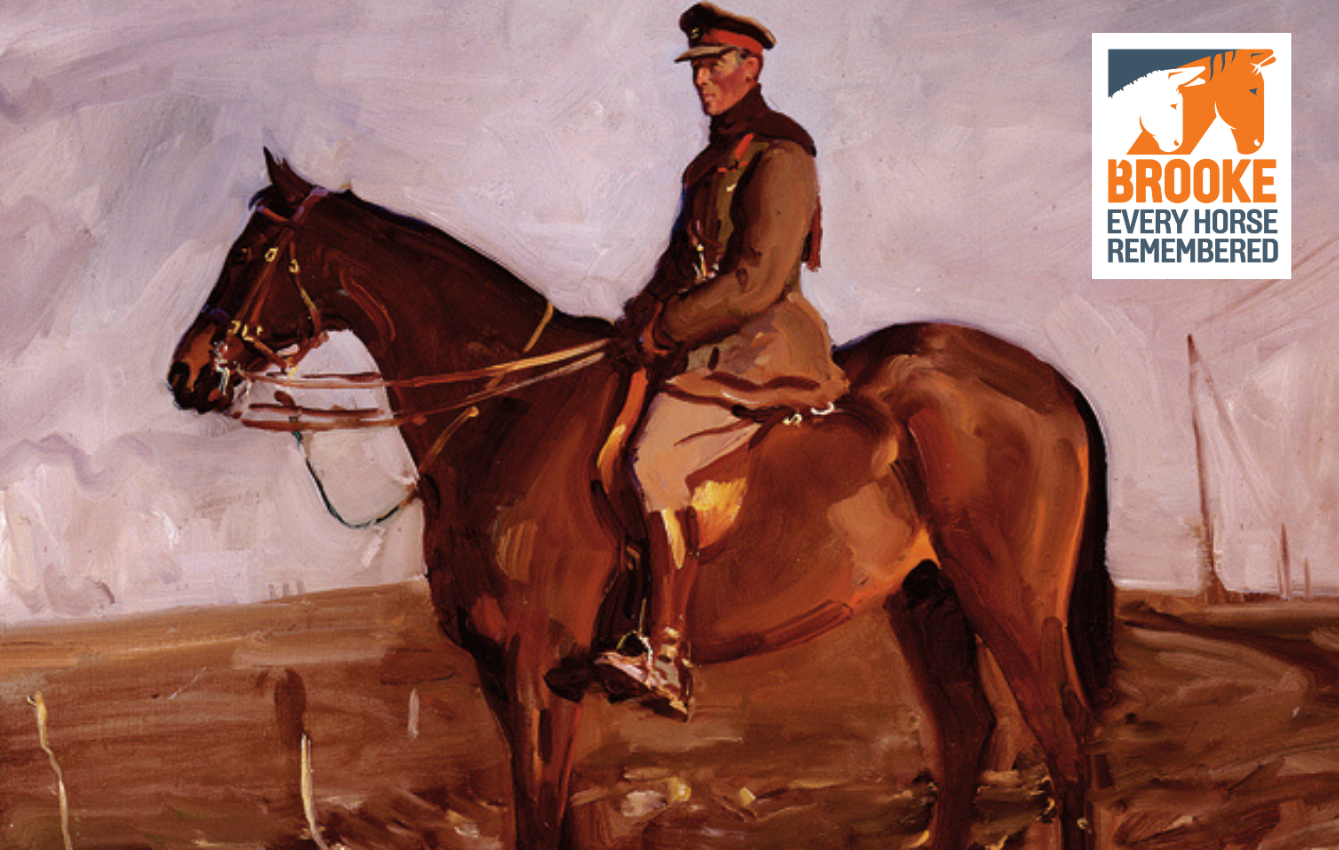
Major General the Rt Hon Jack Seely on Warrior

Image: Major General the Rt Hon Jack Seely on his war horse Warrior

Credit: Painting by Sir Alfred Munnings

“His escapes were quite wonderful. Again and again he survived when death seemed certain… It was not all hazard; sometimes it was due to his intelligence.” — General Jack Seely, about Warrior


Dear Rita,

Warrior was born on the Isle of Wight in 1908. By 1914, he was sent to fight on the Western Front with General Jack Seely. Through mud, shells, machine-gun fire, and unimaginable chaos at the Somme and Ypres, he survived. At Passchendaele he was buried under debris, often stuck in the mud, twice trapped under the burning beams of his stables. Yet he came home. He lived until he was 33. Warrior’s story is one of bravery, survival, and love.

He was not alone. More than 8 million horses, donkeys and mules served in the First World War. Most never made it back.

The Animals in War Memorial Service starts at 11am GMT on 7 November 2025

While Warrior’s battles are finished, thousands of working animals still face hardship every day – animals carrying water, helping families, pulling ploughs, just to make a living possible.

We’re honoured to join Petplan’s Animals in War Memorial Service to remember those animals, past and present.

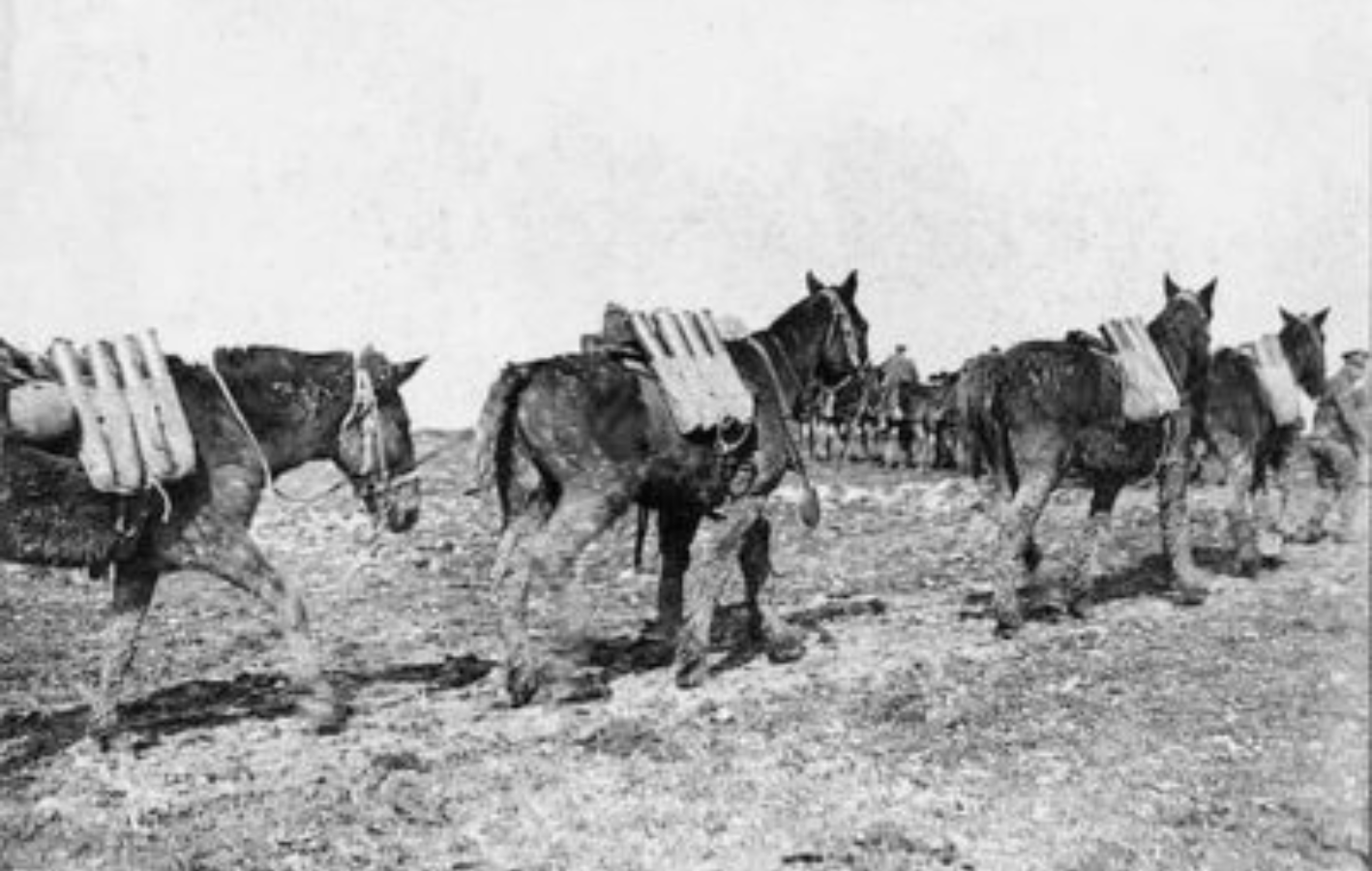
Mules rarely stood in the spotlight, but their courage was no less real. In World War I, they were valued for their endurance: fewer supplies needed, better tolerance to heat and cold, less vulnerable to disease. Mule trains carried vital ammunition and supplies through muddy trenches, sometimes working 14-16 hour shifts under fire.

One mule, carrying soldiers’ mail, acted instinctively as the hillside beneath him gave way, pushing his handler to safety and saving the letters that meant the world to the men at the front. It was an act no one forgot.

Pack mules carrying ammunition
While Warrior’s battles are finished, thousands of working animals still face hardship every day – animals carrying water, helping families, pulling ploughs, just to make a living possible.
We’re honoured to join Petplan’s Animals in War Memorial Service to remember those animals, past and present.

Warrior lived because of courage. So many others gave everything. Thank you for remembering with us, and for helping their stories live on, not just today, but for generations.

With gratitude,

Kylie Thurley
Digital Marketing Manager


Share

HUNGERFORD ARCADE – “PRECIOUS MEMORIES”

Hungerford Arcade has many very interesting customers and David Hirst is one of them.  David is a watercolour artist who specialises in bringing memories to life from photographs of family members, pets or magical holiday places.


David is the person to go to if you would like your precious memories brought back to life.  You can contact David by email on dahirstxyz@gmail.com.  Unfortunately, David does not have a website, but you can see his brochure below.


Hungerford Arcade Blog David Hirst Artist


Hungerford Arcade Blog David Hirst Artist

Hungerford Arcade Blog David Hirst Artist


Hungerford Arcade Blog David Hirst Artist

Share

WALLINGFORD ARCADE – THE GREAT EARTHQUAKE

Hello again,


One of the things that I miss about Hungerford is not being able to pop into the Arcade whenever I feel like doing so.


As some of you know, I am closer to France (around 25 miles) than Hungerford (at a guess 100/200 miles) and because of this I do not have the opportunity to pursue one of my favourite pastimes of browse and find which is short for browsing without any specific aim in mind.  In a way it is like beachcombing.  You never know what you might find apart from pebbles, dead fish and even more pebbles.  If I listed all the things I have come across in the Arcade (and frequently purchased) then it would be like Prime Minister’s Question Time – boring and never ending!


Down here in East Kent one can find interesting things but these are sadly few and far between.  Charity shops seem to think that if anything is over 50 years old then it is massively valuable, which is not always the case.  There are antique shops in the area, which range from the very expensive to ones that are much more reasonable.  This makes it all the more challenging, but just as much fun, as occasionally you find something really interesting, which was the case the other day.


I had not trotted into town thinking about earthquakes even though this part of England is on a plate that I believe originates in Belgium.  But by the time I had trotted back, these awful natural disasters were very much on my mind.


The reason for this was that I had found an incredibly interesting booklet called “The Great Earthquake” which detailed the catastrophic earthquake that struck the Izu Peninsula Yokohama, and shortly after Tokyo, at noon on 1st September 1923.


I had obviously heard of this earthquake and that thousands of people were sadly killed but I was totally unaware of the smaller details which this booklet detailed in the extreme.  It had been printed as a record of the reports in the Japan Chronicle (the date of the booklet was unclear but, at a guess, I would have thought it was produced soon afterwards).

When natural disasters happen many miles distant from our shore, there is sadly a tendency to dismiss them (even in this age of 24/7 coverage) and I wonder how this awful earthquake was viewed in 1923.  There were really only the newspapers in 1923 which would have carried the reports of the disaster but not much more.  And because of this the detail in this publication is quite stunning, as short and long reports have been lifted from the pages of the Japan Chronicle and reproduced.


On the first page alone it notes that the Imperial Palace in Yokohama was on fire. (history tells us that the whole of Yokohama and three quarters of Tokyo were destroyed by fire).  Refugees were reported to be sheltering in parks and that communication with London and other major cities was more or less non existent.  Other pages reveal the fate of diplomatic staff and the state of the Tokyo embassies (it was reported that the American embassy was burnt down but the Ambassador and his wife were safe).  This said, a member of staff in Yokohama, Miss Doris Babbitt, was killed and there were many others reported missing or dead.  Princes are reported dead as well as nameless others by the thousand.  This makes grim reading.


On a more positive note, ships carrying refugees are identified with the names, where possible, of who was on board (an interesting note is that most of the names were European in origin)


 The booklet also contains a number of photographs which detail the destruction caused by the earthquake and the confusion afterwards.


Another interesting item is a newspaper cutting that was attached to my booklet dating from the 23rd March 1932, which notes the retirement of a certain Captain Samuel Robinson, who provided great relief in Yokohama at the time of the 1923 earthquake.  It is reported that Captain Robinson and his ship The Empress of Australia rescued a great number of survivors from the burning harbour at Yokohama and was further involved in the relief effort in the days following the disaster.  


In a way it a window into Japan in the 1920s, which for most of us living nearly a century later is something of a mystery unless you are a student of the subject.  


I have not looked but I would imagine that somewhere on the internet there is a copy of this small publication.  It will probably be a year and a day before I find an item as interesting as this.  And to think I nearly missed it, as it was partially hidden in a pile of of pretty ancient knitting magazines and under a very tatty copy of Jonathan Livingston Seagull (which I also purchased for my daughter to read).


That is the beauty of a browse as you do not know what you will find next.


Happy Hunting

Stuart

Share

HUNGERFORD ARCADE – “COSY COFFEE SHOP”

Hungjerford Arcade Home Page the Arcade's Cosy Coffee ShopkA


To All our Customers


GREAT NEWS!!  Earlier than expected, we are now fully open and serving hot and cold food, coffee, tea, cold drinks cakes and more.


Come along and join us in our beautiful garden area to the rear of the Arcade or upstairs in our Cosy Coffee Shop lounge.


A warn welcome awaits you from Mandi, Ray, Barbara

and all the team at the Cosy Coffee Shop.

Share

HUNGERFORD ARCADE – “THE WEDNESDAY MARKET”

Hungerford Arcade staff and customers can rely on the Wednesday Market coming to town every week.  We stock up on fresh bread and cakes, cheese, eggs and more.  We buy all our fruit and vegetables from the most amazing fruit and veg stall.  Everything is so fresh and delicious.


The fruit and veg stall is very different to what most people are used to.  You just grab a basket and work your way around the different tables, chose your own fruit and vegetables and the quantity you require as you go along.  When finished, you just go the end, get it all weighed and pay your money.  It is amazing how much you can get for a fiver.  I had a big bowl of delicious bananas for just £1!  Best of all, it is right outside the Arcade.


Adrian was doing his usual weekly shop at the market when he met Lucy from the fruit & veg stall.  They got talking and she told him that she is going skydiving in two weeks time to raise lots of money for charity in memory of her grandfather.  What a wonderful, scary thing to do.  Good luck Lucy!


Hungerford Arcade Blog. Adrian and Lucy July 2021


Share

HUNGERFORD ARCADE “COSY COFFEE SHOP”


Work is steaming ahead with our new coffee shop.  Mandi, her dad Ray and mum Barbara are working very hard both inside and outside in the garden area to get the Cosy Coffee Shop ready to open and have penned the following message to bring all their customers upto date with progress.


To All our Customers

A warn welcome to you from all the team at the Cosy Coffee Shop.

From Friday, 9th July, we will have a reduced service and will only be serving hot/cold drinks and an assortment of delicious home made cakes whilst we prepare for our opening day on Tuesday, 20th July.


With thanks, Mandi, Ray, Barbara and the rest of the team.


Share

HUNGERFORD ARCADE – UNEXPECTED TREASURE

Hungerford Arcade is full of thousands of items, from sublime rare antiques to everyday items of no apparent particular significance.  One such item was this ginger beer bottle from A Matthews of Elm Park Road, Reading.


Available from Avril in unit 13, it is a piece of local history as A. Matthews ceased trading in the 1960s.  The Matthews family had a mineral water factory.  In the 1920s they manufactured soft drinks and bottled many different flavours of fruit juces and mineral waters.  A particular line was ginger beer.  During the war, they had the first Pepsi Cola franchise in the UK and delivered to the US Army stationed at Bicester.  So far, just another old bottle….


However, to Alison Clapson it is so much more than that.  She was delighted to find it, as it is part of her family history.  Alison’s maiden name is Matthews and her Dad’s cousin owned the factory.  It was wonderful to be able to reunite her with a memento from her family’s past.


That’s the joy of the Arcade, you never know when you’ll find unexpected treasure!

Share

HUNGERFORD ARCADE – “VINTAGE MILITARY VEHICLES REMEMBERING D-DAY 6TH JUNE 1944”

Hungerford Arcade Vintage Military Vehicles D Day 6th June

Hungerford Arcade was very proud to welcome back the Vintage Military Vehicles for the start of their “Remembering D-Day 1944 Tour”.  We last saw them in November 2020 when they were outside here at the Arcade raising money for the Royal British Legion.


This morning the owner/drivers started off with a hearty English breakfast in Alexander’s Tea Room, upstairs in the Arcade, which opened especially for them, before setting off along the A4 to Savernake Forest visiting the many bunkers and ammunition pits dotted around the forest.


Hungerford Arcade Vintage Military Vehicles D-Day 6th June

Next it is onto Marlborough High Street for a parade through the town and a well earned cup of tea.


Their final destination is Chiseldon.  Chiseldon Army Camp was opened in 1914 and closed in 1962. During both World Wars it was heavily used as a training base for troops. A World War I soldier, Arthur Bullock, recorded overcrowding and appalling conditions, including, in the canteen, having to re-use tables and plates from a previous sitting, on which lay ‘bones and chewed bits of gristle’. He also recalls being kept awake by a St. Bernard dog, ‘the mascot of the camp’.  In World War II the camp was a major base for US Army troops.


Hungerford Arcade Vintage Military Vehicles D Day 6th June

GMC Tipper                                                              Paul with his Dodge Command Vehicle


Hungerford Arcade Vintage Military Vehicles D Day Andy with his Willys Jeep

Hungerford Arcade Military Vehicles D Day 6th June


Andy with his Willys Jeep                                                             Gary’s rare Bedford Tanker


Hungerford Arcade Dodge Weapons Carriier 5th June

June's Land Rover


June;s Beloved Land Rover                                             Liams Dodge Weapons Carrier


Hungerford Arcade Vintage Military Vehicle Event D Day


Have a great day, Gary (the organiser – in green top), June (Gary’s wife and chief Mascot!) Liam, Paul, Andy, Aiden and the honourable gentleman in the beige waistcoat.  Thank you for everything you do for the Armed Forces Memorial Days.

Share

HUNGERFORD ARCADE – OLD FRIENDS

Hungerford Arcade has been especially pleased to see our old friends since re-opening. It is so wonderful to see familiar faces and catch up with what they’ve been doing during the months of lockdown.


We were delighted to welcome back Peter and Sharon Allen, who came from Brighton on a day trip to see us.  They are regular visitors and had stored up a lot of supressed retail therapy as they left with boxes of items from a dozen different dealers!


Peter is a military historian and retired member of the Royal Naval Reserve.  He has a particular interest in the Royal Naval Divisions of the First World War. His website, https://friends-of-the-royal-naval-divisions-in-ww1.co.uk has interesting information about the items in his extensive collection of memorabilia.  He is a great raconteur who researches his finds and has a wealth of fascinating stories to tell.


We look forward to seeing them again soon.

Share

HUNGERFORD ARCADE – “A Miser’s Snuff Box”

Hungerford Arcade Blog Miser;s Snuff Box May 2021

Snuff is a smokeless tobacco made from ground or pulverised tobacco leaves.  It is inhaled or “snuffed” into the nasal cavity, delivering a swift hit of nicotine and a lasting flavoured scent (especially if flavouring has been blended with the tobacco). Traditionally, it is sniffed or inhaled lightly after a pinch of snuff is either placed onto the back surface of the hand, held pinched between thumb and index finger, or held by a specially made “snuffing” device.


Snuff originated in the Americas and was in common use in Europe by the 17th century. Traditional snuff production consists of a lengthy, multi-step process, in tobacco snuff mills. The selected tobacco leaves are first subject to special tobacco curing or fermentation processes, where they will later provide the individual characteristics and flavour for each type of snuff blend.  Snuff is usually scented or flavoured, with many blends of snuff requiring months to years of special storage to reach the required maturity. Typical traditional flavours are varieties of blended tobacco leaves considered original “fine snuff” without any addition of scents or essences. Varieties of spice, piquant, fruit, floral, and mentholated (also called “medicated”) soon followed, either pure or in blends. Each snuff manufacturer usually has a variety of unique recipes and blends, as well as special recipes for individual customers.


Then, of course you had to have a snuff box to keep it fresh. Snuff boxes are made in pocket sizes – holding a few grammes for immediate consumption – and as larger, table boxes. 


Hungerford Arcade Blog Miser's Snuff Box May 2021

The Miser’s Snuff Box – Unit 125


This snuff box is made of brass with a fruitwood base.  It is Scottish and dates from c1840-1860.  The top brass plate with figure of eight opening swivels to correspond with the lower brass plate.  This type of snuff box is often described as a miser’s snuff box as the figure of eight opening only allows one to take a very small pinch of snuff. 


Share