Category: Newsletter

HUNGERFORD ARCADE – “REMEMBRANCE SUNDAY IN HUNGERFORD”

It seemed that the whole of Hungerford turned out today for the Remembrance Day Parade which started in the High Street at 10.30 am and went on to the Bridge Street War Memorial where a service and the two minutes silence was held.  There was a lone bi-plane which flew low over the town as the Town Hall clock struck on the 11th hour, the silence on the street as people, young and old stood reflecting on the 100th anniversary of the end of WWI was very, very moving.


Hungerford Arcade Remembrance Window


Remembrance Day Parade Hungerford


cof

Share

HUNGERFORD ARCADE “VINTAGE MILITARY VEHICLE POPPY APPEAL”

Hungerford Arcade Military Vehicle Appeal

Hungerford Arcade wish to thank Gary, June and all the wonderful men and woman (June with her vintage Land Rover) who brought their vintage military vehicles to Hungerford Arcade and raised lots of money for the Royal British Legion.  Thank you also to our fabulous Dad’s Army Platoon which included Mrs Pyke!  Everyone was fantastic.  Here are some photographs of the event.


Hungerford Arcade Military Vehicle Appeal


Hungerford Arcade Military Vehicle Appeal


Hungerford Arcade Military Vehicles Appeal


Hungerford Arcade Military Vehicles Appeal


Hungerford Arcade Military Vehicles Event

cof


Share

HUNGERFORD ARCADE -NEW “BBC SHOW MAKE ME A DEALER”

Hungerford Arcade BBC Make Me A DeallerHungerford Arcade is very proud to let you know that we have just heard from the BBC that their brand new show, “Make Me A Dealer”, filmed here at the Arcade will be transmitted on  BBC1: 4.30pm on Wednesday 7th November & Friday 9th November 2018.


Don’t forget, you can always catch it on iPlayer for 30 days after its transmission date if you miss it or just want to watch it again!


Share

Hungerford Arcade “The Rolls Royce of Rocking Horses 1864 – 1914”

Hungerford Arcade stallholder, Frances Jones (Unit 46) has a great love of antique rocking horses and with a few at home, decided after many years that it was time for one of them to move on to a new home.  This particular horse was hand-made by F.H. Ayres of London who is widely known as the

maker of the Rolls Royce of rocking horses.  In 1895, the price of one of these rocking horses ranged from 18 shillings to fifty shillings.  Today, a magnificent horse such as this can sell for many thousands of pounds.  


Hungerford Arcade Frances' Rocking Horse

                       This magnificent F.H Ayres Rocking Horse


Share

HUNGERFORD ARCADE “VINTAGE MILITARY VEHICLES EVENT”

SUNDAY, 4th NOVEMBER 2018

10.00 am to 3.30 pm


Hungerford Arcade hold this event each year thanks to Gary and June Crook who bring their ‘army’ of friends to this great event with the aim of raising money for The Royal British Legion.  This being the 100th anniversary of the end of WWI makes it even more special. The drivers bring their own vintage military vehicles along and dress in the forces uniform of the time. They are very special people and like to have a chat about their historic vehicles and what they do with them during the year. Children love it. We are also hoping that a Dad’s Army Platoon will return this year to give us some leadership!


This year, we are very grateful to the Guides who will be here to help. Please do come along and give your support to this great event.  One of the Arcade’s windows is given over every year to commemorate the Armed Forces.  This year, with the help of Di Lock from The Royal British Legion, it will be decorated to commemorate the centenary.


Hungerford Arcade Vintage Military Vehicles

Share

HUNGERFORD ARCADE “SAS AUCTION SHOW AT ARCADE”

Hungerford Arcade is home for many forms of media, TV, Radio and Newspaper/Magazines as its uniqueness lends itself very easily and comfortably to all manner of things.  Even events like our vintage fashion evening and some Arts for Hungerford events.


If you subscribe to our Newsletter, you will see that Thomas Plant and Neil Shuttleworth of SAS Auctions was once again holding their annual, The Great Antiques Pursuit!  show here at the Arcade for Newbury Weekly News.  The idea is that people enter into a competition in the newspaper for a chance to win a day of shopping for antiques with the two experts from the SAS auction house.  They are given £200 to spend on items that will be the most likely to gain a profit at auction, which is then all given to charity.  It was a great fun day and here you can see Arcade co-owner,  Adrian Gilmour thoroughly enjoying himself as did everyone.


Hungerford Arcade SAS Auction Show

L-R Thomas Plant, Adrian Gilmour & Neil Shuttleworth


We are all looking forward very much for the next show!


Share

Hungerford Arcade leaps back to the 40’s!

Here at the Arcade we thought we’d bounced into the 40’s! All thanks to Michele and Adam who came in to tell us about their interest in recreating the feel of the era. With amazing attention to detail, they specialise in British and German military and civilian costumes. Keep and eye out for them at upcoming events.


Share

Hungerford Arcade “Bite Sized Finds”

Hello again,


For those of you who have children or grandchildren it does not take you long to find out that the little darlings are walking germ factories. That was the case with Caron and I who visited both sets of grandchildren recently.  We enjoyed ourselves immensely but foolishly, did not take into account the warnings that we had been given.  That the lovely children had been attending their nurseries for weeks prior to our visits.


Like early European explorers walking into a tropical jungle, we picked the little ones up from the Tiny Tots and Early Years nurseries and were infected almost immediately. Exhausted, we returned to Hungerford and our lives have not been the same since.


I usually try to pop into the Arcade at least once a week, but due to feeling quite ropey, both Caron and I did not, outside of our normal duties, venture out much.


We however decided to visit the Arcade on Saturday last and whilst there, I found an item that I had never knowingly seen before.  We had been perusing for about ten minutes when we made our way towards the Junk Stall which had just been filled up.  Caron picked up some incredibly beautiful porcelain dolls and then spotted a round object hanging from the far wall.  It appeared to be made of Bakelite (which I am a great fan of) but neither Caron or I could make out what it was.


The label noted that it was £3.00 but the description was

a little blurred (neither of us had brought our glasses).  It seemed to state it was a wall protector which confused us both as how could such a small object protect any wall?  It was then that an elderly lady sensing our confusion corrected us.  It was indeed a protector, but it had not been designed to protect walls but to protect bundles of wool when knitting.  When she said that its purpose became obvious.


The woman also added that she clearly remembered her mother using a wool protector similar to the one that was for sale when she was a child.

Hungerford Arcade Blog Stuart Aug 2017

After confirming that she did not want to purchase the item (she said that her house was too full of memories already), I added the wool protector to the items that we were going to buy.  I find it hard to tie a knot at times let alone knit so for the time being the wool protector is hanging from a curtain rail in our lounge.  Caron, who likes knitting, is proposing to use it when she next plans a garment but that will not be for a while, given our present lifestyle.


You will be happy to know that we are fully recovered from our ills and hope to visit the little ones again in August to see what other viruses they can share with us.  We had planned to see my ancient parent this weekend, but for obvious reasons were unable to go.  And because of this was able to pay an unscheduled visit to the Arcade.


If Caron and I had stuck to our original plan then we would have enjoyed the wonders of Westbury but this was not to be.  Caron picked up her beautiful dolls, Pippi and Poppi (don’t ask) and I discovered something that I had never seen before.  I must say, it made us feel a great deal better.


Happy Hunting

Stuart Miller-Osborne   

Share

Hungerford Arcade The Mystery of Samplers

Hungerford Arcade’s wonderful friend and author, Stuart Miller-Osborne has written this amazing article on Samplers.  It is a subject that has always fascinated me and the fact that lighting was so primitive in those days but the girls/women could sew so beautifully.


The Mystery of Samplers


Although I do not own a sampler I have always been fascinated by them as in my view, they open a window quite easily into the past.

Mystery of SamplersBefore writing this short piece, I explored the various antique outlets in Hungerford to see how many I could find.

In the short week of my review, I found some fascinating examples many of which I would have liked to have purchased.


But on the whole, they were out of my determined price range as their cost approached three figures.

Do not let this put you off, as if you purchase a sampler then you will have an item with a unique history hanging from your wall. 


Although they seemed to be purely decorative, samplers actually had a function and this was the reason for their genesis over six hundred years ago.

As most of us are aware, the first book was not published in England until 1477 when William Caxton and his Westminster press made an appearance. S7


But supposing fifty years previously you as a needlewoman were required to follow a pattern, then you had a problem.

You could not nip down to the local library and pick up a book on the subject.

But an answer was to hand, basically a narrow piece of cloth which was used to record the pattern required.

They were logically called samplers (from the French essamplaire which roughly means a work copied). 

In short, you were given (or maybe they were passed down in families) a pattern to follow and you progressed from there.

As books became more popular, it was not that long before the first pattern book was published (in Augsburg in 1523).

S4Others followed and by 1600 the sampler in its initial function was more or less redundant.

Books had had the impact that the internet has had on our everyday lives today.

But although without a job our friend the sampler was not gone and forgotten.


They retained a use for teaching girls the various sewing techniques which would help them in later life.

There were items such as darning samplers and sewing samplers which, as their name implies, were useful when making clothes or just committing repairs to others.

Earlier samplers were nothing like the ones we see in frames today. They were for the most part long and narrow (rather like a margin on an essay) and to some extent, were used for this purpose.

They were working items and it was not until the eighteenth century that samplers began to change their shape.


 They ceased to be long and narrow and became square. Their content was changing as well. Samplers were often used to record events (whether they be good or bad) within families and quite often celebrated God. S5

When visiting the V&A (which has a fantastic collection of samplers) I have found slightly later ones which contain moral verses and the like.


Poems began to appear and representations of birds and trees and houses to name but a few were to be found.

Celebrations of the monarchy and letters of the alphabet were also seen, the latter having a practical use as many people were quite illiterate.

Obviously, techniques changed and to some extent the quality of the materials used, but overall samplers stayed the same.

For some reason, nineteenth century samplers continue to attract my interest, although I have a great admiration for earlier samplers which I have seen in various museums in the UK.

I think my interest stems from the social history of the items. A great number of samplers made in the nineteenth century were executed by younger women as part of their education.

One has only to visit the Hungerford Arcade to see how exquisite these items are. The dexterity in the fingers of these young ladies is astonishing to say the least. 

The hours and days they must have spent on their samplers do not warrant calculation.

This is the attraction of samplers to me and I believe this attraction is shared by many others as samplers do not seem to remain in the Arcade for very long.

The Victorian samplers also act as family diaries recording (as I have previously noted) births, deaths and marriages.

They remind me of Victorian family Bibles which quite often retain these records.

Some are incredibly sad, a living record of their creation.


S1In a reference book I am reading, the author mentions a Martha Grant who appears to have started a sampler at the age of ten in 1833. This date is enclosed in a cartouche on the left hand side of the work.


But opposite there is a second cartouche which records her date of death which was on the 31st of October 1834.


Obviously, she could not have added the latter detail and one wonders whether Martha actually started the sampler as the technique is constant throughout.

Maybe the sampler was created by her sister or her mother in memory of Martha, this is hard to determine..

It is a mystery of time which will not be resolved.

At the time of writing (July 2015), there are a couple of lovely Victorian samplers in the Arcade that you can admire even if you do not purchase them. If my memory serves me correctly, one of them dates from 1821 and although not as tragic as Martha’s sampler, it is incredibly interesting and one feels that they are looking at life nearly two hundred years ago.

Queen Victoria would have only been two and the poets Shelley and Byron would have been at the height of their powers.

Poor Keats would have been in Italy in search of a respite in his terrible disease.

But somewhere in the United Kingdom, a young lady ( I cannot remember her name) would have been working on a sampler maybe as an education or maybe for her complete pleasure.

Little would she have known that her delicate work would be for sale in our small West Berkshire town in 2015.

As with Martha, this young craftswoman has faded into history leaving very few clues. 

That is the fascination for me, the obscurity of time. Each time I see a Victorian sampler I think of its creator and admire the beauty of their work.


S2

This said, some samplers from the period are charmingly eccentric in their presentation. You often find capital letters in the middle of words and very occasionally misspellings. I saw a lovely one in Dorchester about twenty years ago where there were a large number of spelling mistakes in a simple prayer (God grace, His keapimg etc etc).


I am sure that young Emma Simpson (I remember her name clearly to this day) was either dyslexic or was just rather bad at spelling or was doing the sampler as a punishment and was totally disinterested.

The overall presentation was charmingly chaotic and I wish that I had purchased the sampler at the time.

But I was on my way to Weymouth Sands and to have had a sampler plus two children in tow would have not been practical.

It was also raining at times that day and we spend a number of hours in nearby Preston drinking endless cups of tea.

I should have taken the plunge as the dealer was asking a very fair price for the item.

I will buy a Victorian sampler one day.

I will find the right one which attracts me instantly and I will behave foolishly with my wallet. But not for now.

Price wise, as I have already noted, you can expect to pay a good price for a Victorian sampler (I have not seen any created before 1800 for sale for many years).

If you budget around one hundred pounds then I think you will find an acceptable example to purchase. This said, you can pay a lot less or a lot more.

The cheapest sampler that I have seen recently was one that was created in 1927 which was a bargain at twelve pounds.

It was not as ornamental as the Victorian samplers but was a fine work.

In Henley recently, I found a rather crudely worked sampler dating from 1864 for sale for twenty-eight pounds which was good value.

It is a matter of searching around.

 When you find the sampler that really attracts, you will buy it even if it is a little out of your range. 

If I was successful with my lottery ambitions then I would start a museum for samplers for future generations to enjoy, from Miss Simpson’s mischief to the most exquisite Victorian workings. 

I think this would be fun and would inspire people to pursue this art which still has a following but in my view is a little under the radar at present.

But I may be wrong and happily so.   


Stuart Miller-Osborne


Share

HUNGERFORD ARCADE – THE BENTLEY BOYS

One of the joys of living in this corner of West Berkshire is that frequently ones sees a vintage car pass on one of the local roads. The driver is open to the air as the car glides without effort towards its destination. Most people pause for a moment to witness the beauty of the machine. It is inbuilt in us, we all  like witnessing the machines of yesteryear in fine working order, whether it be a steam train crossing the bridge at Hungerford or a vintage car on the road.


In these days of high performance cars, I believe that for some of us the actual thrill of driving along the open road has been diluted and given the chance, we would all like to drive a vintage car. Imagine the thrill of driving through the Savernake Forest with its peculiar geography and arriving in Marlborough for tea and buttered scones, whilst looking out of the window at your machine parked proudly in the island on the main street.


Unfortunately, many of us do not have pockets deep enough to be able to experience this first hand, but we can buy framed prints and old photographs of these machines to place on our walls. In most antique shops and arcades, one will find these pictures, which are well worth collecting. They are usually representations of a racing car at speed with the driver in a white helmet. The background is blurred and sometimes you are informed of who the driver was and maybe the event represented.


In these days of hi-tech formula one racing one feels an immediate nostalgia for these brave pioneers, many of who died young in their early machines. But what of these men who risked life and limb in the first three decades of the twentieth century?


Tim Birkin with
Malcolm Campbell

My father mentioned The Bentley Boys when he took me to a race meeting when I was quite young and I remembered these men without really knowing too much about them. That was until about twenty years ago when I came across a framed photograph of a certain Tim Birkin (1896-1933) who was one of these famous Bentley Boys. It was then I decided to research the history of these drivers.


In the 1920s, it was quite expensive to run a car (nothing has changed you may say) and to race one was even more demanding on ones finances. The Bentley Boys were a bunch of enthusiasts who were not by any means on the breadline. They were to some extent the bright young things of the era. Anybody who has read Evelyn Waugh will recognise the type of person. This is not to say they were dilettantes, they were deadly serious about their pursuits.


They were called The Bentley Boys because obviously they drove the famous Bentley car. As we all know, the Bentley was a car with a reputation for high performance and reliability. You paid for what you drove and this was what the marque represented. In 1925  the Bentley brand ran into problems and probably the most famous of The Bentley Boys, Woolf Barnato (1895-1948) purchased the company and in time developed the memorable Bentley Blower car.


The company which was based in Cricklewood and with its dedication and innovation, led to four consecutive wins at the 24 Hour Le Mans race between 1927 and 1930. The main competitor, the Italian Bugatti, which was much more lightweight and fragile, was no match for the more rugged Bentley’s which, as my researches indicate, were sometimes called “ The worlds fastest lorries”.


Barnato’s Gurney Nutting Sportsman Coupé, often believed to be the car that raced the Blue Train despite being delivered to Barnato weeks after the race

Craig Howell from San Carlos, CA, USA, CC BY 2.0 <https://creativecommons.org/licenses/by/2.0>, via Wikimedia Commons

In the early 1930s there were the Blue Train Races between cars and the Le Train Bleu which took place between Calais and the French Riviera some 750 miles apart. Woolf in March 1930 actually raced the Blue Train from Cannes to Calais  and won and in time the Blue Train Bentleys were developed and sold.  But as with F Scott Fitzgerald’s novels set in the South of France and Waugh’s main characters the good times were not going to last forever. The depression that hit the world in the 1930s soon hit the demand for the Bentley cars which were never that cheap in first place and in time, the company was sold to Rolls Royce.


There were a number of Bentley Boys apart from Woolf, one of these was Clive Dunfree (1904-1932) who was sadly killed in a spectacular crash at Brooklands which I believe was recorded on the newsreel of the time. He was married to the actress Jane Baxter (1909-1996) who was of the leading lights of the British cinema in the 1930s. It was all very glamorous in what was a dour decade.


Another was Tim Birkin who raced at Brooklands a few times as well as Le Mans which he won in 1931 in a Alfa Romeo (He actually received a telegram of congratulation from Mussolini at the time). Tim actually raced John Cobb (1899-1952) at Brooklands as the result of a wager. This is commemorated in a painting by the artist Terence Cuneo.


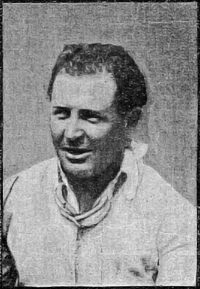
Kidston – Autocar 1931

I did not purchase the photograph of Tim Birkin but wish I had as I knew my father would have been very interested at the time. The well known Glen Kidston (1899-1931) was another member of The Bentley Boys who was known for his racing and other exploits. If you want to see a more comprehensive list of The Bentley Boys then the internet has plenty of information and has helped me in my researches.


One of the many family holidays I took as a child was to Pendine Sands in Wales. As many of us know, this is a vast stretch of beach (some seven miles long). I can remember walking with my father on the beach one day and he told me that a racing car was buried under the sands after a fatal accident many years ago. He really did not elaborate, but the subject fascinated me especially after reading an article in a motoring magazine some years later. I was aware that the sands had been used as the venue for car and motorcycle races since the beginning of the 20th century but what I did not realise was that it was also the venue for attempts at the world land speed record and this lead to the burial of the machine.


Babs

edvvc from London, UK, CC BY 2.0 <https://creativecommons.org/licenses/by/2.0>, via Wikimedia Commons


The driver in question was John Godfrey Parry-Thomas (1884-1927) as with The Bentley Boys, he had connections with Brooklands but here the similarities ended. Unlike the Bentley clan, he lived a very quiet life but still won over thirty races in five or so seasons. But Parry-Thomas was looking beyond that at the world land speed record. He developed a car named Babs which he took to Pendine Sands and on the 28th April 1926 achieved over 170 mph a speed record which stood for nearly a year.


His great rival was Malcolm Campbell (1885-1948). Soon Campbell reached 174 mph in his famous Bluebird. This lead to an attempt on the 3rd March 1927 by Parry – Thomas. Sadly due to a mechanical fault Babs crashed and killed Parry-Thomas. This was the final attempt at speed records on Pendine Sands. Babs was buried in the dunes near the village of Pendine and remained there until 1969 (some two or three years after our previous visit) when Owen Wyn Owen a restorer and mechanic recovered the wreck.

As you would think, Babs was in a terrible state after being buried for some forty two years. But with a great deal of effort and dedication Babs was rebuilt and was actually driven again. Babs can be seen at the Pendine Museum of Speed and at times at the Brooklands museum. I have not yet seen her but look forward to meeting her when I am next in the area.


Blue Bird, Pendine, January 1927

Andy Dingley (scanner), Public domain, via Wikimedia Commons

I have already noted that you can quite easily find racing memorabilia in antique shops and the Arcade. Apart from framed prints and photographs, these men also I believe, appeared on cigarette cards and maybe postcards. I do not really collect these as I have more of a nostalgic interest than an actual interest in motor racing. As with a number of people, I like to see the ships, trains, aeroplanes and cars of previous years. I also like the supposed romance of the era and when thinking about these things, it brings back memories of those times spent at Pendine Sands with my father and the long forgotten race meetings we occasionally attended.


Stuart Miller-Osborne

Share